Dhaka 10:50 pm, Wednesday, 29 July 2026

What We See in Football— How Much of It Is True?

Shahria Nayan
  • Publish : 10:42:44 pm, Wednesday, 29 July 2026
  • / 3

File photo

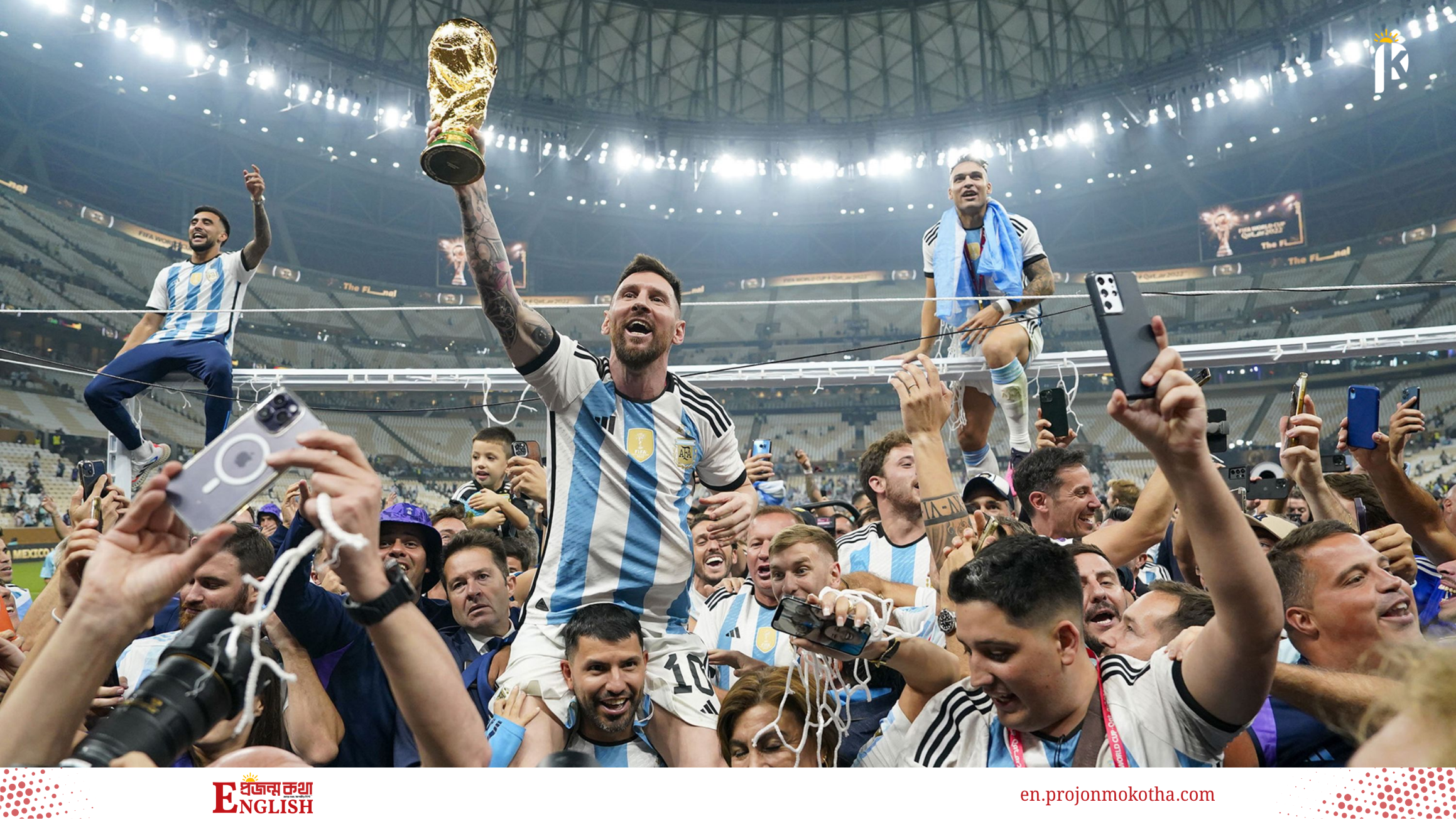
The 2026 FIFA World Cup is over. A new champion has lifted the trophy, and another chapter has been added to history. But just as every World Cup writes the story of a trophy, it also leaves behind certain questions. This tournament is no exception.

But has a question ever truly made us pause? Is the 90 minutes we watch on the pitch the whole truth? Or does something bigger lie behind that spectacle where football becomes entangled in complex equations of power and interest?

History tells us that the World Cup is not merely the history of football. It is also the history of power.

Over nearly a hundred years, many events have unfolded on the World Cup stage where forces outside football— politics, dictatorship, war, diplomacy, economic interests, and the equations of international power have come to the centre of discussion. In some cases, the World Cup was used as a tool for a ruler’s propaganda. In others, it served as a curtain to hide national crises. And sometimes, a single match became the symbolic battleground of a political conflict between two nations. Many of these incidents are no longer mere controversies they are now part of recorded history, documented through the research of historians, government files, and the testimonies of eyewitnesses.

This article does not claim to provide definitive answers to those questions. Because to establish any accusation as truth, the burden of proof must be met. Yet one thing is undeniable— the World Cup’s history contains many events that were never confined to football alone. At various times, politics, war, dictatorship, economics, commercial interests and the equations of international power have surrounded the World Cup with controversy. The purpose of this article is to examine the events of 2026 through the lens of that historical reality.

The purpose of this article is not to establish any conspiracy theory as truth. Rather, it is to raise a continuous question in the light of history.

If the World Cups of 1930, 1934, 1938, 1978, 1986 and 1990 are still being researched, debated, and yielding new documents today, then history itself grants us the right to question the 2026 World Cup.

That is why this article will attempt to analyse the 2026 final not as an isolated match, but as part of a long continuum nearly a century of World Cup history, the politics of power, geopolitics and global economic interests.

So there is only one central question in this article was the World Cup always only a football story? Or did it sometimes become the greatest stage for world politics?

To find the answer to that question, we must go back nearly a hundred years, to the history of the World Cup’s birth to the part written in textbooks, and to the part that is not.

The Birth of the World Cup: The History Everyone Knows, and the History Nobody Tells

In the 1920s, Olympic football was largely restricted to amateur players. Professional footballers from many countries could not participate. This gave rise to the need for an independent international tournament. By then, football had gained enormous popularity across Europe, South America and other parts of the world. FIFA wanted to launch an international competition to take that popularity to a global level. The then-FIFA president Jules Rimet believed that football could unite people of different nations. Under his leadership, the decision to organise the FIFA World Cup was taken in 1928, and the first World Cup was held in 1930.

That much, people know. But very few people know the other history that lies on the reverse side. Just as the World Cup began with a message of peace, it also has another, darker chapter behind it. One of the major purposes behind the World Cup’s founding was to hide the oppression of powerful authoritarian rulers from the global eye, and to grant legitimacy to those regimes.

British football historian David Goldblatt, in his celebrated work The Ball is Round: A Global History of Football (2006), wrote that the World Cup’s birth did not stem from the joy of the game alone — behind it lay the calculations of political power. He showed that from the 1930s onwards, dictators of various countries used the World Cup as a tool to polish their international image.

American writer Franklin Foer made this relationship even clearer in his book How Soccer Explains the World (2004). He wrote that football sometimes becomes so intertwined with nationalism and political power that there is no longer any boundary between sport and politics.

Goldblatt, in The Ball is Round, made a key observation— that throughout the twentieth century, whenever political crises or public anger against authoritarian rule intensified in any country, football or a major sporting event would divert that attention elsewhere.

It was in the midst of the ongoing Iran-Israel-United States conflict that the 2026 FIFA World Cup began. For nearly two months, while the World Cup was held, that conflict continued— yet the greater part of the global media’s attention and the attention of ordinary people was fixed on the World Cup stage. This is not coincidence. It is a familiar pattern, one whose roots go back to the 1930s.

The 1930 World Cup: Controversy at the Very First Tournament

Even before the first World Cup final took place on the pitch, an unprecedented dispute had already begun. Belgian referee John Langenus later wrote in his memoirs: “An extraordinary animosity between the two countries became apparent when the time came to choose the match ball. Both teams insisted on playing with their own ball.”

FIFA president Jules Rimet ultimately brokered a compromise. It was decided that Argentina’s ‘tiento’ ball would be used in the first half, and Uruguay’s Scotland-imported ‘T-model’ ball in the second. This remains the only World Cup final in history in which two different balls were used.

The difference between the two balls was fundamental. Argentina’s ‘tiento’ was made from twelve long leather panels heavier and less elastic. Uruguay’s ‘T-model’ was comparatively lighter and faster.

The effect was visible in the result. In the first half, with Argentina’s ball, Argentina went ahead 2-1. The tournament’s top scorer Guillermo Stábile scored the second goal just before half-time, keeping Argentina in front.

But with the change of ball at half-time, the course of the match changed as well. Uruguay dominated the second half entirely with their lighter ball. In the 57th minute, Pedro Cea levelled; in the 68th, Santos Iriarte put Uruguay ahead. Just before the final whistle, Héctor Castro scored the fourth. Uruguay won 4-2 and lifted the first World Cup.

After the final, stones were thrown at Uruguay’s consulate in Buenos Aires; an angry group of Argentine supporters attacked the consulate building. This ball dispute was not merely the controversy of one match it sowed the seeds of a hundred years of football rivalry between two neighbouring nations.

David Goldblatt, in The Ball is Round, documented this ball controversy as the first administrative dispute in World Cup history, and showed how decisions made off the pitch can influence outcomes on it. That lesson was learned at the very first World Cup.

Mussolini’s World Cup: 1934 and 1938

The 1934 World Cup was held in fascist Italy. Historian Simon Martin, in his research monograph Football and Fascism: The National Game under Mussolini (2004), showed that Mussolini invested 3.5 million lire in that tournament. The purpose was singular to grant legitimacy to fascism on the world stage.

But the most startling piece of information concerns the referee. The semi-final of the 1934 World Cup was officiated by Swedish referee Ivan Eklind. The night before the match, Mussolini personally invited him to dinner— ostensibly for ‘tactical discussions’. The following day, Italy beat Austria 1-0. Austria’s legendary striker Josef Bican maintained until his dying day that Eklind had taken a bribe. He said that the referee himself had once touched the ball and directed it towards an Italian player.

That same referee, Eklind, was then appointed to the final. And before the final, he was invited to the fascist VIP box. Italy beat Czechoslovakia 2-1 to become champions.

The 1938 World Cup was held in France. But Mussolini’s shadow was there too. The night before every match, Mussolini personally sent each player a letter. The message was brief but terrifying: “Win, or die.”

Sportskeeda’s historical report documents that Hungarian goalkeeper Antal Szabó, after conceding four goals in the 1938 final, still said: “I conceded four goals, it’s true— but I saved the lives of the Italian players.” Italy beat Hungary 4-2 in that final to win back-to-back World Cups.

Historian Denis Mack Smith, in his book Mussolini (1983), showed that for Mussolini, sport was a powerful instrument of political propaganda. Two World Cup victories made fascist rule more accepted in the minds of the Italian public.

British historian R.J.B. Bosworth, in his book Mussolini’s Italy: Life Under the Fascist Dictatorship (2005), wrote that Mussolini used the World Cup as proof of the legitimacy of his rule. Italy’s victories were presented as the triumph of fascist ideology.

Mussolini was one of the most notorious dictators of the twentieth century. Under his rule, through the suppression of political opponents, the curtailment of press freedom, military aggression and alliance with Nazi Germany, Italy became a fully fascist state. On 28 April 1945, Italian resistance fighters shot him dead.

The 1978 World Cup: A Torture Chamber Right Next to the Stadium

On 24 March 1976, through a military coup, General Jorge Rafael Videla’s military junta seized power in Argentina. What followed was one of the most brutal episodes of political repression in history, known as the ‘Dirty War’ or ‘Guerra Sucia’.

Argentina’s human rights body CONADEP’s 1984 official investigation report, Nunca Más (Never Again), documented that during this period, at least 30,000 people were disappeared, tortured and killed. This report remains the most important human rights document in Argentina’s history.

British journalist Jonathan Wilson, in Angels with Dirty Faces: The Footballing History of Argentina (2016), wrote that the organisation of the 1978 World Cup was a carefully calculated political project of the Videla government. Its primary aim was to present Argentina to the international community as a stable, peaceful nation.

The most horrifying detail is this: just a few hundred metres from the Estadio Monumental in Buenos Aires, where World Cup matches were being played, stood the notorious naval torture centre known as ESMA. Human rights researcher Marguerite Feitlowitz, in her book A Lexicon of Terror: Argentina and the Legacies of Torture (1998, Oxford University Press), recorded the testimonies of survivors. They reported that even as spectators in the stadium were celebrating goals, the torture of prisoners was continuing in the rooms of ESMA. Their cries were being swallowed by the roar of the crowd.

The Peru Match: One of the Most Disputed Results in History

In the second round of the 1978 World Cup, Argentina needed to beat Peru by at least four goals to reach the final. Argentina won that match 6-0.

This result has been the subject of multiple investigations and studies in the decades since. A lengthy investigative report by journalist Richard Fiddler, published in the British newspaper The Guardian, claimed that Argentina’s military government had reached a secret political understanding with Peru’s military government. In exchange, it is alleged that Argentina arranged grain exports and bank loans to Peru.

Questions were also raised about the role of Peru’s then-goalkeeper Ramón Quiroga, who was Argentine-born. Although no definitive proof was ever established in court, David Goldblatt, in The Ball is Round, wrote that this match would forever remain one of the most suspicious results in World Cup history.

FIFA subsequently changed the tournament schedule so that the crucial final-round matches would take place simultaneously. Many experts see this decision as an indirect acknowledgement of what happened in 1978.

The Hand of God: Revenge on the Pitch, a Wound in History

In the 1982 Falklands War, 649 Argentine soldiers lost their lives. The grief of defeat and the loss of the islands had been deeply embedded in Argentine society. Historian Lawrence Freedman, in his book The Official History of the Falklands Campaign (2005, Routledge), documented in detail the political and human impact of that war.

Four years later, in the 1986 World Cup quarter-final, Maradona scored against England with his hand. Speaking to journalists after the match, he said the goal was scored “a little with the head of Maradona and a little with the hand of God.”

But in Maradona’s autobiography El Diego (2000), he was more explicit: that goal was his tribute to the Argentine soldiers killed in the Falklands War. He wrote: “I robbed the English. It was revenge for that war.”

British football writer Jimmy Burns, in his book Maradona: The Hand of God (1996), showed that this goal was not merely an illegal goal— it was a political statement. To hundreds of millions of Latin Americans, this goal was a symbolic reply to European colonial power.

In the 2026 semi-final, Argentina once again defeated England. After the match, the players displayed a banner reading “Malvinas Argentinas”, reigniting the old controversy. The dispute over the Falkland Islands remains unresolved. This battle on the pitch is therefore not mere football it is the reflection of a century of political relations.

Football’s Truth or Illusion? The Cry of the Lower Class in the Game of the Upper Class

Here, a fundamental question arises. Whose interests does the World Cup serve?

Karl Marx, in Das Kapital (1867), argued that in a capitalist system, the class that controls the economy also determines truth. FIFA is that upper class. The billions of World Cup spectators are the lower class. No matter how loudly the lower class shouts or questions, those questions never reach the halls of the upper class. The upper class uses emotion, festivity and entertainment as its weapons to keep people in line. The World Cup is the most powerful version of that weapon.

This becomes even clearer through Marx’s concept of Commodity Fetishism. Billions of people attach special value to a World Cup jersey, a ball, a brand. But the labour behind those products, whose profit it generates, and whose decisions it reflects those questions remain firmly outside the conversation.

A research paper published by TeleSUR English, Global Capital Determines World Cup Champions (2026), stated plainly that Western Europe, as the financial centre of world football, maintains its dominance. Europe’s multi-billion-dollar club leagues absorb talented players from Africa, Asia and Latin America from childhood.

A paper published in the Journal of Political Inquiry, titled This Is How Football Became a Tool of Modern Imperialism (2025), noted that in 2021, the English Premier League’s broadcasting revenue alone was £5 billion, whereas all of Africa’s leagues combined generated less than £1 billion. FIFA, European clubs and corporate sponsors control world football’s wealth, while Africa, Latin America and Eastern Europe remain as suppliers of raw material.

This is where the question of imperialism enters. For centuries, Europe has centralised the world’s resources in its own hands. Football is no exception to that system. A research paper published on ResearchGate, European Club Capitalism and FIFA Redistribution Models (2018), citing the analysis of Sugden and Tomlinson, noted that for the countries of the developing world, FIFA was once viewed as a platform of resistance against imperialism but today, European dominance within the organisation’s power structure is unquestionable.

The 2026 World Cup generated a record 15 billion US dollars in revenue for FIFA surpassing their own initial target of 11 billion. The lion’s share of that income came from European broadcasting rights and sponsorships. The question then is: would Europe’s billion-dollar commercial interests want a Latin American team to win the World Cup? Would European sponsors prefer more jerseys of a Latin American country to be sold over those of Spain?

Sociologist Jean Baudrillard, in Simulacra and Simulation (1981), showed how modern media creates an artificial version of reality to control public consciousness. In that sense, the World Cup is a global ‘simulation’ where billions of people are absorbed in the emotion of the game while the political and economic structures behind it remain invisible.

The 2026 World Cup: A Football Festival in the Fire of War

Historian Noam Chomsky, in Hegemony or Survival: America’s Quest for Global Dominance (2003, Metropolitan Books), showed in detail how the United States applies political and diplomatic pressure on allied nations to serve its military interests. The use of European bases for military operations in the Middle East is not new. In 2003, before the Iraq War, France and Germany also refused. This time, Washington asked for permission to use Spain’s military bases for strikes on Iran. The Spanish government clearly refused.

This immediately raised the question: did the Trump administration use the football stage as well, to keep Spain on side and maintain its grip on European politics?

Political scientist Joseph Nye, in Soft Power: The Means to Success in World Politics (2004, PublicAffairs), showed that great powers use cultural and sporting diplomacy alongside military force as tools of influence.

How far the reach of the US administration extended as host country became most visibly apparent in the Round of 32 match against Bosnia. American striker Folarin Balogun received a straight red card following VAR review for stepping on the ankle of Bosnian defender Tarik Muharemović. By FIFA rules, this meant he could not play in the crucial Round of 16 match against Belgium. But what happened next was unprecedented in football history.

US President Donald Trump directly called FIFA president Gianni Infantino and asked for the red card decision to be reviewed. Following Trump’s intervention, FIFA’s Disciplinary Committee used Article 27 of their own Disciplinary Code to suspend Balogun’s one-match ban for one year. Balogun subsequently took the field against Belgium.

This decision provoked fierce reaction across the football world. UEFA, Europe’s governing body for football, stated in a formal communiqué that the decision had “crossed a red line” and was “unprecedented, incomprehensible and unjustifiable.” Former FIFA president Sepp Blatter wrote: “Red cards are not cancelled by political phone calls. If a US president calls the FIFA president and a player suddenly gets clearance, the question is inevitable: FIFA, where are you heading?”

War Hidden in the Glare of the World Cup

On 28 February 2026, the United States and Israel jointly launched a military operation against Iran under the name ‘Operation Epic Fury’. This was the largest US military operation in the Middle East since the 2003 invasion of Iraq. The primary objective was to destroy Iran’s nuclear capability and weaken the country’s leadership. Iran’s Supreme Leader Ayatollah Khamenei was killed in the American strikes.

40,000 US troops were deployed in the operation. B-2 stealth bombers flew 30-hour missions from Missouri to strike Iran. More than 2,500 Iranian military and government installations in Tehran, Isfahan, Qom, Karaj, Kermanshah and Tabriz were simultaneously attacked. 13 American soldiers were killed and more than 290 wounded in the operation.

According to data from the Human Rights Activists News Agency (HRANA) of Iran, by 10 June 2026, at least 3,468 people had been killed in Iran. Among the dead were seven children, 376 minors and 496 women. More than 26,000 people were wounded, including at least 4,000 women and 1,621 children.

By the 143rd day of the war, the total death toll across all sides ranged from 7,144 to more than 9,676, with the number of wounded reaching approximately 46,965. More than 4,000 people were killed in Lebanon. US military costs reached approximately 5.14 billion dollars.

It was in the midst of this devastating war that the 2026 FIFA World Cup began on American soil, organised by America itself. For nearly two months, while the World Cup was held, strikes on Iran continued. Yet the greater share of the global media’s attention was fixed on the World Cup stage. News of thousands of deaths was moving to the back pages, while goal celebrations moved to the front. The ‘pattern of distraction’ that David Goldblatt described in The Ball is Round found its fullest expression in 2026.

A Warring Nation’s Players on the Enemy’s Soil

One of the most discussed chapters of the 2026 World Cup was the participation of Iran’s national football team.

Professor Jules Boykoff of Pacific University, an expert in international sports politics, told Time magazine: “Never before in World Cup history has it happened that the host country launched a full-scale war against a participating nation just three months before the tournament began.”

Chomsky, in Hegemony or Survival, referred to this kind of strategy as ‘manufactured consent’ where the public’s attention is diverted from war towards entertainment, freeing those in power from accountability. The 2026 World Cup became a near-perfect example of that process.

After war broke out, President Trump in March advised Iran not to participate in the World Cup. He said that Iran’s players’ “lives and safety” could be at risk.

Due to the circumstances, Iran’s national team was forced to establish their base camp in Mexico rather than the United States. Players were only permitted to enter the US on match days. After each match, they were required to return to Mexico. Several team officials were also denied American visas.

Iran’s Football Federation directly accused the United States of “vengeful behaviour.” Even for the World Cup draw ceremony in Washington, the visas of Federation president Mehdi Taj and other senior officials were denied, leading Iran to boycott the draw ceremony. The country called the decision “unsportsmanlike.”

Professor Boykoff said that what had never happened in World Cup history happened in 2026 a country waging active military war against another was simultaneously allowing that nation’s players to compete on its own soil, but on limited terms. This dangerous mixing of sport and politics was unprecedented in football history.

Another example of this abnormal reality came on the day of the Iran-Egypt match. Just a few hours before kick-off, US forces bombed several islands in Iran’s southern Strait of Hormuz. On one side, warplanes in the sky on the other, that very country’s players competing in a World Cup match. Such a contradiction is rare in the history of international sport.

Franklin Foer, in How Soccer Explains the World, wrote that football sometimes becomes so intertwined with nationalism and political power that there is no longer any boundary between sport and politics. In 2026, that boundary was not merely blurred it was deliberately erased.

Jean Baudrillard, in Simulacra and Simulation, showed how modern media creates an artificial version of reality to control public attention. Thousands of people were dying on the battlefield, but the global media was busy analysing World Cup goals. In 1934, Mussolini’s Italy used the World Cup to give fascism legitimacy on the world stage. Did the United States of 2026 do anything different? I leave that question to the reader’s judgement.

The Somali Referee: Africa’s Best, Turned Away at Miami Airport

Sports historian David Goldblatt, in The Ball is Round, wrote that when any country hosts the World Cup, that country’s political power finds opportunities to exert influence beyond the pitch. In 2026, the most human manifestation of that truth was a 34-year-old Somali referee.

Omar Abdulkadir Artan, born in Mogadishu, was listed by FIFA as a referee in 2018. In 2025, he received recognition as Africa’s best male referee, and was one of 52 referees selected by FIFA for the 2026 World Cup. He had been selected by FIFA after a three-year vetting process. He would have been the first Somali ever to referee at a World Cup.

On 6 June 2026, Artan arrived at Miami International Airport from Istanbul. US Customs and Border Protection blocked his entry, citing “vetting concerns.” Artan reported that during hours of interrogation, he was asked about Somali politics and an extremist group. Despite holding a diplomatic passport and a valid visa, he was sent back.

White House World Cup Task Force executive director Andrew Giuliani told CBS News that Artan had been “speaking with some very bad people,” claiming there was classified information on the matter that could not yet be disclosed. Yet FIFA had selected Artan through a three-year vetting process. FIFA president Infantino said: “Unfortunate, but we cannot control everything.”

Noam Chomsky, in Hegemony or Survival, showed that when an imperialist power is the host of any event, the rules of that event also fall under that power’s political interests. This is exactly what happened to Artan. The Trump administration’s travel ban covers approximately 40 countries, most of them African. This ban is not only political — it is effectively a framework of racial discrimination that followed its subject even onto the World Cup stage.

Howard Zinn, in A People’s History of the United States, wrote that throughout US history, minorities and people from poorer countries have repeatedly been marginalised under the guise of national security. Artan’s story is a new chapter in that long history.

Within days of the incident, UEFA appointed Artan as the referee for the European Super Cup final between PSG and Aston Villa. The one whom the United States considered a ‘security risk,’ Europe entrusted with officiating its most prestigious match.

Back in Mogadishu, thousands of supporters lifted Artan on their shoulders. He said: “What’s happened has happened. I will go to the next World Cup.” Somalia is not a World Cup-participating nation — but that day, a stadium in Mogadishu was full. Not for a goal. For the dignity of one human being.

Pierre Bourdieu, in The Logic of Practice (1990, Stanford University Press), showed that sporting institutions are not outside the broader structures of power in society. Artan’s case is living proof of that truth. If a referee is judged by the country in his passport rather than his performance on the pitch, then how much of the World Cup truly belongs to the “world” that is a question history itself will one day answer.

How Much of What We See at the World Cup Is True?

Sports researcher Pierre Bourdieu, in The Logic of Practice (1990, Stanford University Press), showed that sporting institutions are not outside the broader structures of power in society. When state and economic interests come into conflict, sporting institutions frequently yield to that pressure. This statement has been proven true again and again in World Cup history.

Since I have no definitive evidence in hand, I will tell no imaginary story. But I wish to share what history does say. Because the question is important how much of what we saw on our television screens at the 2026 World Cup was true? The right to ask that question is one that history itself grants us.

On 8 July 1990, at the Stadio Olimpico in Rome, West Germany beat Argentina 1-0 in the final. In the 85th minute, Andreas Brehme converted a controversial penalty against Rudi Völler. The statistics say West Germany took 23 shots in that match, while Argentina had just one the most one-sided figures in World Cup final history.

At the final whistle, Maradona was in tears, and at the medal ceremony he refused to shake hands with Brazilian FIFA president João Havelange. Afterwards, Maradona told anyone who would listen that Havelange had stolen the World Cup from him. This accusation has since appeared in multiple football research publications.

This allegation of Havelange’s bias is not mere emotion. After Swiss court documents were made public in 2012, it emerged that Havelange and his son-in-law Ricardo Teixeira had accepted millions of dollars in bribes from international sports marketing company ISL. David Goldblatt, in The Ball is Round, wrote that FIFA’s institutional power structure had always been built in such a way that the organisation’s commercial and political interests could influence the football on the pitch.

If the 1990 allegations remained at the level of suspicion, by 2015 that institutional corruption was proven in court. In 2015, US prosecutors published charges involving more than 150 million dollars in bribes and kickbacks connected to FIFA. Multiple senior officials were sentenced to prison.

Sociologist Jean Baudrillard, in Simulacra and Simulation, showed how institutions maintain credibility by constructing an artificial version of reality. For decades, FIFA did exactly that— a mask of transparency on the outside, a web of corruption within.

The questions being raised today about Infantino Balogun’s ban reversed after Trump’s phone call, the silence over the Somali referee’s exclusion are therefore not entirely new.

Historian Howard Zinn, in A People’s History of the United States (1980), wrote that the powerful have a tremendous capacity to conceal the truth but history has shown that truth always surfaces eventually.

In 1934 and 1938, the story of Mussolini’s World Cup of the referee invited to dinner the night before the semi-final came to light decades later. The story of the secret political arrangement behind the Peru match in 1978 emerged years afterwards. Havelange’s bribery became public knowledge nearly fifteen years after he left office. The 2015 FIFA scandal also eventually came to light through the courts.

Franklin Foer, in How Soccer Explains the World, wrote that whatever happens at the intersection of football and power its truth is not written on the pitch. It is written on the pages of history.

If the 2026 World Cup was tainted by controversy, that truth too will emerge one day. Today or a hundred years from now. Because in World Cup history, some matches do not end in 90 minutes. Some matches end many years later, when history finally reveals the full picture.

But football’s history has said one thing again and again truth can never be buried forever.

This is not the end— but the beginning of another chapter of history…
Share This News

What We See in Football— How Much of It Is True?

Publish : 10:42:44 pm, Wednesday, 29 July 2026

The 2026 FIFA World Cup is over. A new champion has lifted the trophy, and another chapter has been added to history. But just as every World Cup writes the story of a trophy, it also leaves behind certain questions. This tournament is no exception.

But has a question ever truly made us pause? Is the 90 minutes we watch on the pitch the whole truth? Or does something bigger lie behind that spectacle where football becomes entangled in complex equations of power and interest?

History tells us that the World Cup is not merely the history of football. It is also the history of power.

Over nearly a hundred years, many events have unfolded on the World Cup stage where forces outside football— politics, dictatorship, war, diplomacy, economic interests, and the equations of international power have come to the centre of discussion. In some cases, the World Cup was used as a tool for a ruler’s propaganda. In others, it served as a curtain to hide national crises. And sometimes, a single match became the symbolic battleground of a political conflict between two nations. Many of these incidents are no longer mere controversies they are now part of recorded history, documented through the research of historians, government files, and the testimonies of eyewitnesses.

This article does not claim to provide definitive answers to those questions. Because to establish any accusation as truth, the burden of proof must be met. Yet one thing is undeniable— the World Cup’s history contains many events that were never confined to football alone. At various times, politics, war, dictatorship, economics, commercial interests and the equations of international power have surrounded the World Cup with controversy. The purpose of this article is to examine the events of 2026 through the lens of that historical reality.

The purpose of this article is not to establish any conspiracy theory as truth. Rather, it is to raise a continuous question in the light of history.

If the World Cups of 1930, 1934, 1938, 1978, 1986 and 1990 are still being researched, debated, and yielding new documents today, then history itself grants us the right to question the 2026 World Cup.

That is why this article will attempt to analyse the 2026 final not as an isolated match, but as part of a long continuum nearly a century of World Cup history, the politics of power, geopolitics and global economic interests.

So there is only one central question in this article was the World Cup always only a football story? Or did it sometimes become the greatest stage for world politics?

To find the answer to that question, we must go back nearly a hundred years, to the history of the World Cup’s birth to the part written in textbooks, and to the part that is not.

The Birth of the World Cup: The History Everyone Knows, and the History Nobody Tells

In the 1920s, Olympic football was largely restricted to amateur players. Professional footballers from many countries could not participate. This gave rise to the need for an independent international tournament. By then, football had gained enormous popularity across Europe, South America and other parts of the world. FIFA wanted to launch an international competition to take that popularity to a global level. The then-FIFA president Jules Rimet believed that football could unite people of different nations. Under his leadership, the decision to organise the FIFA World Cup was taken in 1928, and the first World Cup was held in 1930.

That much, people know. But very few people know the other history that lies on the reverse side. Just as the World Cup began with a message of peace, it also has another, darker chapter behind it. One of the major purposes behind the World Cup’s founding was to hide the oppression of powerful authoritarian rulers from the global eye, and to grant legitimacy to those regimes.

British football historian David Goldblatt, in his celebrated work The Ball is Round: A Global History of Football (2006), wrote that the World Cup’s birth did not stem from the joy of the game alone — behind it lay the calculations of political power. He showed that from the 1930s onwards, dictators of various countries used the World Cup as a tool to polish their international image.

American writer Franklin Foer made this relationship even clearer in his book How Soccer Explains the World (2004). He wrote that football sometimes becomes so intertwined with nationalism and political power that there is no longer any boundary between sport and politics.

Goldblatt, in The Ball is Round, made a key observation— that throughout the twentieth century, whenever political crises or public anger against authoritarian rule intensified in any country, football or a major sporting event would divert that attention elsewhere.

It was in the midst of the ongoing Iran-Israel-United States conflict that the 2026 FIFA World Cup began. For nearly two months, while the World Cup was held, that conflict continued— yet the greater part of the global media’s attention and the attention of ordinary people was fixed on the World Cup stage. This is not coincidence. It is a familiar pattern, one whose roots go back to the 1930s.

The 1930 World Cup: Controversy at the Very First Tournament

Even before the first World Cup final took place on the pitch, an unprecedented dispute had already begun. Belgian referee John Langenus later wrote in his memoirs: “An extraordinary animosity between the two countries became apparent when the time came to choose the match ball. Both teams insisted on playing with their own ball.”

FIFA president Jules Rimet ultimately brokered a compromise. It was decided that Argentina’s ‘tiento’ ball would be used in the first half, and Uruguay’s Scotland-imported ‘T-model’ ball in the second. This remains the only World Cup final in history in which two different balls were used.

The difference between the two balls was fundamental. Argentina’s ‘tiento’ was made from twelve long leather panels heavier and less elastic. Uruguay’s ‘T-model’ was comparatively lighter and faster.

The effect was visible in the result. In the first half, with Argentina’s ball, Argentina went ahead 2-1. The tournament’s top scorer Guillermo Stábile scored the second goal just before half-time, keeping Argentina in front.

But with the change of ball at half-time, the course of the match changed as well. Uruguay dominated the second half entirely with their lighter ball. In the 57th minute, Pedro Cea levelled; in the 68th, Santos Iriarte put Uruguay ahead. Just before the final whistle, Héctor Castro scored the fourth. Uruguay won 4-2 and lifted the first World Cup.

After the final, stones were thrown at Uruguay’s consulate in Buenos Aires; an angry group of Argentine supporters attacked the consulate building. This ball dispute was not merely the controversy of one match it sowed the seeds of a hundred years of football rivalry between two neighbouring nations.

David Goldblatt, in The Ball is Round, documented this ball controversy as the first administrative dispute in World Cup history, and showed how decisions made off the pitch can influence outcomes on it. That lesson was learned at the very first World Cup.

Mussolini’s World Cup: 1934 and 1938

The 1934 World Cup was held in fascist Italy. Historian Simon Martin, in his research monograph Football and Fascism: The National Game under Mussolini (2004), showed that Mussolini invested 3.5 million lire in that tournament. The purpose was singular to grant legitimacy to fascism on the world stage.

But the most startling piece of information concerns the referee. The semi-final of the 1934 World Cup was officiated by Swedish referee Ivan Eklind. The night before the match, Mussolini personally invited him to dinner— ostensibly for ‘tactical discussions’. The following day, Italy beat Austria 1-0. Austria’s legendary striker Josef Bican maintained until his dying day that Eklind had taken a bribe. He said that the referee himself had once touched the ball and directed it towards an Italian player.

That same referee, Eklind, was then appointed to the final. And before the final, he was invited to the fascist VIP box. Italy beat Czechoslovakia 2-1 to become champions.

The 1938 World Cup was held in France. But Mussolini’s shadow was there too. The night before every match, Mussolini personally sent each player a letter. The message was brief but terrifying: “Win, or die.”

Sportskeeda’s historical report documents that Hungarian goalkeeper Antal Szabó, after conceding four goals in the 1938 final, still said: “I conceded four goals, it’s true— but I saved the lives of the Italian players.” Italy beat Hungary 4-2 in that final to win back-to-back World Cups.

Historian Denis Mack Smith, in his book Mussolini (1983), showed that for Mussolini, sport was a powerful instrument of political propaganda. Two World Cup victories made fascist rule more accepted in the minds of the Italian public.

British historian R.J.B. Bosworth, in his book Mussolini’s Italy: Life Under the Fascist Dictatorship (2005), wrote that Mussolini used the World Cup as proof of the legitimacy of his rule. Italy’s victories were presented as the triumph of fascist ideology.

Mussolini was one of the most notorious dictators of the twentieth century. Under his rule, through the suppression of political opponents, the curtailment of press freedom, military aggression and alliance with Nazi Germany, Italy became a fully fascist state. On 28 April 1945, Italian resistance fighters shot him dead.

The 1978 World Cup: A Torture Chamber Right Next to the Stadium

On 24 March 1976, through a military coup, General Jorge Rafael Videla’s military junta seized power in Argentina. What followed was one of the most brutal episodes of political repression in history, known as the ‘Dirty War’ or ‘Guerra Sucia’.

Argentina’s human rights body CONADEP’s 1984 official investigation report, Nunca Más (Never Again), documented that during this period, at least 30,000 people were disappeared, tortured and killed. This report remains the most important human rights document in Argentina’s history.

British journalist Jonathan Wilson, in Angels with Dirty Faces: The Footballing History of Argentina (2016), wrote that the organisation of the 1978 World Cup was a carefully calculated political project of the Videla government. Its primary aim was to present Argentina to the international community as a stable, peaceful nation.

The most horrifying detail is this: just a few hundred metres from the Estadio Monumental in Buenos Aires, where World Cup matches were being played, stood the notorious naval torture centre known as ESMA. Human rights researcher Marguerite Feitlowitz, in her book A Lexicon of Terror: Argentina and the Legacies of Torture (1998, Oxford University Press), recorded the testimonies of survivors. They reported that even as spectators in the stadium were celebrating goals, the torture of prisoners was continuing in the rooms of ESMA. Their cries were being swallowed by the roar of the crowd.

The Peru Match: One of the Most Disputed Results in History

In the second round of the 1978 World Cup, Argentina needed to beat Peru by at least four goals to reach the final. Argentina won that match 6-0.

This result has been the subject of multiple investigations and studies in the decades since. A lengthy investigative report by journalist Richard Fiddler, published in the British newspaper The Guardian, claimed that Argentina’s military government had reached a secret political understanding with Peru’s military government. In exchange, it is alleged that Argentina arranged grain exports and bank loans to Peru.

Questions were also raised about the role of Peru’s then-goalkeeper Ramón Quiroga, who was Argentine-born. Although no definitive proof was ever established in court, David Goldblatt, in The Ball is Round, wrote that this match would forever remain one of the most suspicious results in World Cup history.

FIFA subsequently changed the tournament schedule so that the crucial final-round matches would take place simultaneously. Many experts see this decision as an indirect acknowledgement of what happened in 1978.

The Hand of God: Revenge on the Pitch, a Wound in History

In the 1982 Falklands War, 649 Argentine soldiers lost their lives. The grief of defeat and the loss of the islands had been deeply embedded in Argentine society. Historian Lawrence Freedman, in his book The Official History of the Falklands Campaign (2005, Routledge), documented in detail the political and human impact of that war.

Four years later, in the 1986 World Cup quarter-final, Maradona scored against England with his hand. Speaking to journalists after the match, he said the goal was scored “a little with the head of Maradona and a little with the hand of God.”

But in Maradona’s autobiography El Diego (2000), he was more explicit: that goal was his tribute to the Argentine soldiers killed in the Falklands War. He wrote: “I robbed the English. It was revenge for that war.”

British football writer Jimmy Burns, in his book Maradona: The Hand of God (1996), showed that this goal was not merely an illegal goal— it was a political statement. To hundreds of millions of Latin Americans, this goal was a symbolic reply to European colonial power.

In the 2026 semi-final, Argentina once again defeated England. After the match, the players displayed a banner reading “Malvinas Argentinas”, reigniting the old controversy. The dispute over the Falkland Islands remains unresolved. This battle on the pitch is therefore not mere football it is the reflection of a century of political relations.

Football’s Truth or Illusion? The Cry of the Lower Class in the Game of the Upper Class

Here, a fundamental question arises. Whose interests does the World Cup serve?

Karl Marx, in Das Kapital (1867), argued that in a capitalist system, the class that controls the economy also determines truth. FIFA is that upper class. The billions of World Cup spectators are the lower class. No matter how loudly the lower class shouts or questions, those questions never reach the halls of the upper class. The upper class uses emotion, festivity and entertainment as its weapons to keep people in line. The World Cup is the most powerful version of that weapon.

This becomes even clearer through Marx’s concept of Commodity Fetishism. Billions of people attach special value to a World Cup jersey, a ball, a brand. But the labour behind those products, whose profit it generates, and whose decisions it reflects those questions remain firmly outside the conversation.

A research paper published by TeleSUR English, Global Capital Determines World Cup Champions (2026), stated plainly that Western Europe, as the financial centre of world football, maintains its dominance. Europe’s multi-billion-dollar club leagues absorb talented players from Africa, Asia and Latin America from childhood.

A paper published in the Journal of Political Inquiry, titled This Is How Football Became a Tool of Modern Imperialism (2025), noted that in 2021, the English Premier League’s broadcasting revenue alone was £5 billion, whereas all of Africa’s leagues combined generated less than £1 billion. FIFA, European clubs and corporate sponsors control world football’s wealth, while Africa, Latin America and Eastern Europe remain as suppliers of raw material.

This is where the question of imperialism enters. For centuries, Europe has centralised the world’s resources in its own hands. Football is no exception to that system. A research paper published on ResearchGate, European Club Capitalism and FIFA Redistribution Models (2018), citing the analysis of Sugden and Tomlinson, noted that for the countries of the developing world, FIFA was once viewed as a platform of resistance against imperialism but today, European dominance within the organisation’s power structure is unquestionable.

The 2026 World Cup generated a record 15 billion US dollars in revenue for FIFA surpassing their own initial target of 11 billion. The lion’s share of that income came from European broadcasting rights and sponsorships. The question then is: would Europe’s billion-dollar commercial interests want a Latin American team to win the World Cup? Would European sponsors prefer more jerseys of a Latin American country to be sold over those of Spain?

Sociologist Jean Baudrillard, in Simulacra and Simulation (1981), showed how modern media creates an artificial version of reality to control public consciousness. In that sense, the World Cup is a global ‘simulation’ where billions of people are absorbed in the emotion of the game while the political and economic structures behind it remain invisible.

The 2026 World Cup: A Football Festival in the Fire of War

Historian Noam Chomsky, in Hegemony or Survival: America’s Quest for Global Dominance (2003, Metropolitan Books), showed in detail how the United States applies political and diplomatic pressure on allied nations to serve its military interests. The use of European bases for military operations in the Middle East is not new. In 2003, before the Iraq War, France and Germany also refused. This time, Washington asked for permission to use Spain’s military bases for strikes on Iran. The Spanish government clearly refused.

This immediately raised the question: did the Trump administration use the football stage as well, to keep Spain on side and maintain its grip on European politics?

Political scientist Joseph Nye, in Soft Power: The Means to Success in World Politics (2004, PublicAffairs), showed that great powers use cultural and sporting diplomacy alongside military force as tools of influence.

How far the reach of the US administration extended as host country became most visibly apparent in the Round of 32 match against Bosnia. American striker Folarin Balogun received a straight red card following VAR review for stepping on the ankle of Bosnian defender Tarik Muharemović. By FIFA rules, this meant he could not play in the crucial Round of 16 match against Belgium. But what happened next was unprecedented in football history.

US President Donald Trump directly called FIFA president Gianni Infantino and asked for the red card decision to be reviewed. Following Trump’s intervention, FIFA’s Disciplinary Committee used Article 27 of their own Disciplinary Code to suspend Balogun’s one-match ban for one year. Balogun subsequently took the field against Belgium.

This decision provoked fierce reaction across the football world. UEFA, Europe’s governing body for football, stated in a formal communiqué that the decision had “crossed a red line” and was “unprecedented, incomprehensible and unjustifiable.” Former FIFA president Sepp Blatter wrote: “Red cards are not cancelled by political phone calls. If a US president calls the FIFA president and a player suddenly gets clearance, the question is inevitable: FIFA, where are you heading?”

War Hidden in the Glare of the World Cup

On 28 February 2026, the United States and Israel jointly launched a military operation against Iran under the name ‘Operation Epic Fury’. This was the largest US military operation in the Middle East since the 2003 invasion of Iraq. The primary objective was to destroy Iran’s nuclear capability and weaken the country’s leadership. Iran’s Supreme Leader Ayatollah Khamenei was killed in the American strikes.

40,000 US troops were deployed in the operation. B-2 stealth bombers flew 30-hour missions from Missouri to strike Iran. More than 2,500 Iranian military and government installations in Tehran, Isfahan, Qom, Karaj, Kermanshah and Tabriz were simultaneously attacked. 13 American soldiers were killed and more than 290 wounded in the operation.

According to data from the Human Rights Activists News Agency (HRANA) of Iran, by 10 June 2026, at least 3,468 people had been killed in Iran. Among the dead were seven children, 376 minors and 496 women. More than 26,000 people were wounded, including at least 4,000 women and 1,621 children.

By the 143rd day of the war, the total death toll across all sides ranged from 7,144 to more than 9,676, with the number of wounded reaching approximately 46,965. More than 4,000 people were killed in Lebanon. US military costs reached approximately 5.14 billion dollars.

It was in the midst of this devastating war that the 2026 FIFA World Cup began on American soil, organised by America itself. For nearly two months, while the World Cup was held, strikes on Iran continued. Yet the greater share of the global media’s attention was fixed on the World Cup stage. News of thousands of deaths was moving to the back pages, while goal celebrations moved to the front. The ‘pattern of distraction’ that David Goldblatt described in The Ball is Round found its fullest expression in 2026.

A Warring Nation’s Players on the Enemy’s Soil

One of the most discussed chapters of the 2026 World Cup was the participation of Iran’s national football team.

Professor Jules Boykoff of Pacific University, an expert in international sports politics, told Time magazine: “Never before in World Cup history has it happened that the host country launched a full-scale war against a participating nation just three months before the tournament began.”

Chomsky, in Hegemony or Survival, referred to this kind of strategy as ‘manufactured consent’ where the public’s attention is diverted from war towards entertainment, freeing those in power from accountability. The 2026 World Cup became a near-perfect example of that process.

After war broke out, President Trump in March advised Iran not to participate in the World Cup. He said that Iran’s players’ “lives and safety” could be at risk.

Due to the circumstances, Iran’s national team was forced to establish their base camp in Mexico rather than the United States. Players were only permitted to enter the US on match days. After each match, they were required to return to Mexico. Several team officials were also denied American visas.

Iran’s Football Federation directly accused the United States of “vengeful behaviour.” Even for the World Cup draw ceremony in Washington, the visas of Federation president Mehdi Taj and other senior officials were denied, leading Iran to boycott the draw ceremony. The country called the decision “unsportsmanlike.”

Professor Boykoff said that what had never happened in World Cup history happened in 2026 a country waging active military war against another was simultaneously allowing that nation’s players to compete on its own soil, but on limited terms. This dangerous mixing of sport and politics was unprecedented in football history.

Another example of this abnormal reality came on the day of the Iran-Egypt match. Just a few hours before kick-off, US forces bombed several islands in Iran’s southern Strait of Hormuz. On one side, warplanes in the sky on the other, that very country’s players competing in a World Cup match. Such a contradiction is rare in the history of international sport.

Franklin Foer, in How Soccer Explains the World, wrote that football sometimes becomes so intertwined with nationalism and political power that there is no longer any boundary between sport and politics. In 2026, that boundary was not merely blurred it was deliberately erased.

Jean Baudrillard, in Simulacra and Simulation, showed how modern media creates an artificial version of reality to control public attention. Thousands of people were dying on the battlefield, but the global media was busy analysing World Cup goals. In 1934, Mussolini’s Italy used the World Cup to give fascism legitimacy on the world stage. Did the United States of 2026 do anything different? I leave that question to the reader’s judgement.

The Somali Referee: Africa’s Best, Turned Away at Miami Airport

Sports historian David Goldblatt, in The Ball is Round, wrote that when any country hosts the World Cup, that country’s political power finds opportunities to exert influence beyond the pitch. In 2026, the most human manifestation of that truth was a 34-year-old Somali referee.

Omar Abdulkadir Artan, born in Mogadishu, was listed by FIFA as a referee in 2018. In 2025, he received recognition as Africa’s best male referee, and was one of 52 referees selected by FIFA for the 2026 World Cup. He had been selected by FIFA after a three-year vetting process. He would have been the first Somali ever to referee at a World Cup.

On 6 June 2026, Artan arrived at Miami International Airport from Istanbul. US Customs and Border Protection blocked his entry, citing “vetting concerns.” Artan reported that during hours of interrogation, he was asked about Somali politics and an extremist group. Despite holding a diplomatic passport and a valid visa, he was sent back.

White House World Cup Task Force executive director Andrew Giuliani told CBS News that Artan had been “speaking with some very bad people,” claiming there was classified information on the matter that could not yet be disclosed. Yet FIFA had selected Artan through a three-year vetting process. FIFA president Infantino said: “Unfortunate, but we cannot control everything.”

Noam Chomsky, in Hegemony or Survival, showed that when an imperialist power is the host of any event, the rules of that event also fall under that power’s political interests. This is exactly what happened to Artan. The Trump administration’s travel ban covers approximately 40 countries, most of them African. This ban is not only political — it is effectively a framework of racial discrimination that followed its subject even onto the World Cup stage.

Howard Zinn, in A People’s History of the United States, wrote that throughout US history, minorities and people from poorer countries have repeatedly been marginalised under the guise of national security. Artan’s story is a new chapter in that long history.

Within days of the incident, UEFA appointed Artan as the referee for the European Super Cup final between PSG and Aston Villa. The one whom the United States considered a ‘security risk,’ Europe entrusted with officiating its most prestigious match.

Back in Mogadishu, thousands of supporters lifted Artan on their shoulders. He said: “What’s happened has happened. I will go to the next World Cup.” Somalia is not a World Cup-participating nation — but that day, a stadium in Mogadishu was full. Not for a goal. For the dignity of one human being.

Pierre Bourdieu, in The Logic of Practice (1990, Stanford University Press), showed that sporting institutions are not outside the broader structures of power in society. Artan’s case is living proof of that truth. If a referee is judged by the country in his passport rather than his performance on the pitch, then how much of the World Cup truly belongs to the “world” that is a question history itself will one day answer.

How Much of What We See at the World Cup Is True?

Sports researcher Pierre Bourdieu, in The Logic of Practice (1990, Stanford University Press), showed that sporting institutions are not outside the broader structures of power in society. When state and economic interests come into conflict, sporting institutions frequently yield to that pressure. This statement has been proven true again and again in World Cup history.

Since I have no definitive evidence in hand, I will tell no imaginary story. But I wish to share what history does say. Because the question is important how much of what we saw on our television screens at the 2026 World Cup was true? The right to ask that question is one that history itself grants us.

On 8 July 1990, at the Stadio Olimpico in Rome, West Germany beat Argentina 1-0 in the final. In the 85th minute, Andreas Brehme converted a controversial penalty against Rudi Völler. The statistics say West Germany took 23 shots in that match, while Argentina had just one the most one-sided figures in World Cup final history.

At the final whistle, Maradona was in tears, and at the medal ceremony he refused to shake hands with Brazilian FIFA president João Havelange. Afterwards, Maradona told anyone who would listen that Havelange had stolen the World Cup from him. This accusation has since appeared in multiple football research publications.

This allegation of Havelange’s bias is not mere emotion. After Swiss court documents were made public in 2012, it emerged that Havelange and his son-in-law Ricardo Teixeira had accepted millions of dollars in bribes from international sports marketing company ISL. David Goldblatt, in The Ball is Round, wrote that FIFA’s institutional power structure had always been built in such a way that the organisation’s commercial and political interests could influence the football on the pitch.

If the 1990 allegations remained at the level of suspicion, by 2015 that institutional corruption was proven in court. In 2015, US prosecutors published charges involving more than 150 million dollars in bribes and kickbacks connected to FIFA. Multiple senior officials were sentenced to prison.

Sociologist Jean Baudrillard, in Simulacra and Simulation, showed how institutions maintain credibility by constructing an artificial version of reality. For decades, FIFA did exactly that— a mask of transparency on the outside, a web of corruption within.

The questions being raised today about Infantino Balogun’s ban reversed after Trump’s phone call, the silence over the Somali referee’s exclusion are therefore not entirely new.

Historian Howard Zinn, in A People’s History of the United States (1980), wrote that the powerful have a tremendous capacity to conceal the truth but history has shown that truth always surfaces eventually.

In 1934 and 1938, the story of Mussolini’s World Cup of the referee invited to dinner the night before the semi-final came to light decades later. The story of the secret political arrangement behind the Peru match in 1978 emerged years afterwards. Havelange’s bribery became public knowledge nearly fifteen years after he left office. The 2015 FIFA scandal also eventually came to light through the courts.

Franklin Foer, in How Soccer Explains the World, wrote that whatever happens at the intersection of football and power its truth is not written on the pitch. It is written on the pages of history.

If the 2026 World Cup was tainted by controversy, that truth too will emerge one day. Today or a hundred years from now. Because in World Cup history, some matches do not end in 90 minutes. Some matches end many years later, when history finally reveals the full picture.

But football’s history has said one thing again and again truth can never be buried forever.

This is not the end— but the beginning of another chapter of history…